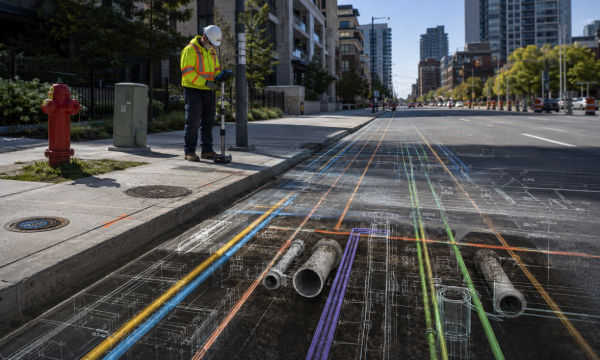
Subsurface Utility Engineering White Paper: Applying ASCE 38-22 in Practice
Practical guidance for planning and applying SUE investigations to support better project decisions
Subsurface Utility Engineering (SUE) provides project owners, engineers and designers with a structured process for investigating and documenting existing utilities before they become a constraint on design or construction.
The current ASCE/UESI/CI 38-22 Standard Guideline for Investigating and Documenting Existing Utilities replaces the former ASCE 38-02 standard and expands the framework around Utility Quality Levels, investigation requirements, utility attributes, depth information, documentation and professional judgment. ASCE describes the standard as both prescriptive and performance-based, recognizing that the appropriate timing, sequencing, location and scope of a utility investigation depend on the requirements of the project.
But applying SUE effectively requires more than simply selecting a Quality Level.
A practical utility investigation develops information progressively. Quality Level D (QL-D) establishes what utilities are known or suspected to be present through records and available documentation. Quality Level C (QL-C) adds visible field evidence such as maintenance holes, hydrants, valves, pedestals and other utility features. Together, this information provides the context required to conduct a thorough Quality Level B (QL-B) geophysical investigation.
This sequence matters. Detecting one buried line does not necessarily establish that every utility within a corridor has been identified. Urban corridors in particular can contain several generations of infrastructure installed at different times, using different materials and following different alignments. Understanding what should be present helps guide the field investigation and identify information that remains unresolved. The updated white paper explains this integrated D–C–B approach in detail.
At the same time, not every utility requires the same level of investigation. The appropriate effort depends on the proposed work and the decisions that must be made. QL-A direct exposure and measurement can be particularly valuable where precise horizontal or vertical information will determine whether a design can proceed as proposed, whether an existing utility can be accommodated, or whether utility relocation and additional coordination may be required.
multiVIEW’s updated SUE White Paper provides practical guidance for developing an investigation that is comprehensive where it needs to be, targeted where appropriate, and aligned with the information requirements of the project.
What You’ll Learn
- How QL-D, QL-C and QL-B work together — and why records and visible utility evidence are essential to a well-informed geophysical investigation.
- How to determine the appropriate level of effort based on project limits, proposed construction and the utility information actually required for design.
- When QL-A adds meaningful value, particularly where precise utility position can change a design or utility-accommodation decision.
- How to select investigation technologies appropriately, recognizing that no single geophysical method can detect every utility in every environment.
- What SUE deliverables should communicate, including Quality Levels, investigation limits, utility attributes, unresolved information and other factors needed to understand and use the results.
Download the White Paper
Subsurface Utility Engineering: Applying ASCE 38-22 in Practice
Practical guidance for owners, engineers, designers and project teams planning subsurface utility investigations.
Link to File: multiVIEW_Locates-Inc_SUE_White_Paper_ASCE_38-22