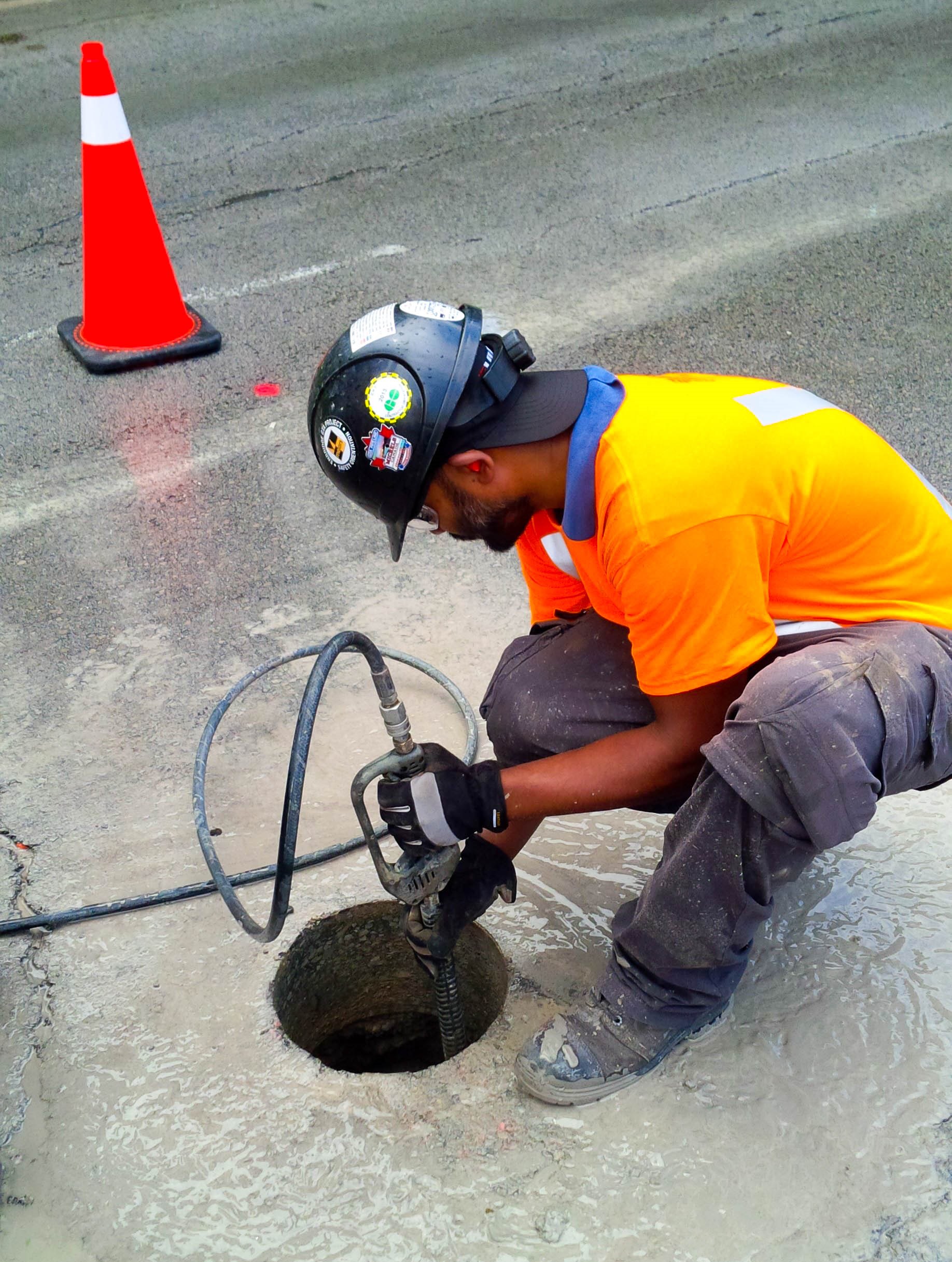
Vacuum Excavation technology is used to remove below surface materials safely with no manual hand-tooling required in the process. The benefits of Vacuum excavation include:
- eliminating the hazard of underground utility strikes
- minimizing traffic disruption
- reducing reinstatement costs
- lessen the manpower and equipment needed for each job
There all several different industries that can benefit from Vacuum Excavation including railways, civil works, highways, power plants, waterworks, gas utilities, power utilities, construction, and telecom.
Hydro Vacuum Excavation for Subsurface Utility Engineering
Vacuum Excavation is utilized as a data collection activity for Subsurface Utility Engineering Quality Level A activities. Potholing, daylighting, or test pitting occurs to expose and verify the physical characteristics of a utility or structure housing utilities, including its Geodetic location. It is applied when data is required on utility depth, composition, and type. This data is then integrated with information gleaned from Quality Levels D, C and B and reflected on a CAD drawing.
How does Vacuum Excavation work?
Vacuum Excavation utilizes high-powered fans to safely excavate up to 141 feet (43 metres) of depth depending on the configuration. First, a small surface area hole of about 10 inches (250 mm) is created, this may vary depending on the ground conditions. Then the suction excavator hose removes below surface materials. Compressed air is used to fracture the ground for the suction excavator to be able to remove the material safely.
Using a powerful vacuum and high-pressure water, prices holes, trenches, and tunnels can be cut to the required size and proportion. Because compressed air or water is used to loosen the earth, the risk of damaging underground utilities is less, and contractors can safely find and expose them. Often excavation reveals unknown utilities, saving workers from injury, money, and time.

Hydro vs. Pneumatic Vacuum Excavation
The two most popular methods are pneumatic excavation and hydro excavation. In pneumatic excavation, high-speed airflow is used to loosen the material covering the target and the soil is sucked away with the vacuum tube. This soil can be used as native backfill as it is not mixed with any other materials.
During hydro excavation, a high-pressure water jet is used and where required, at high temperatures, to loosen the material covering the target, including frozen ground. This method is suitable for any soil type. On hard surfaces such as asphalt or concrete, a coring system is applied prior to excavation to expose the soil surface.